
Damaged Composite Boards: When a Repair Works and When It Does Not
Most damaged composite decking can be repaired without a new deck, and in New Braunfels we start every repair at the frame. Marks and mildew usually come off with periodic cleaning with soap and water. A loose board can usually be refastened, and a cracked one can be lifted out and swapped on its own. The catch is underneath: if the joists below have rot, the frame gets fixed before any new board goes down.
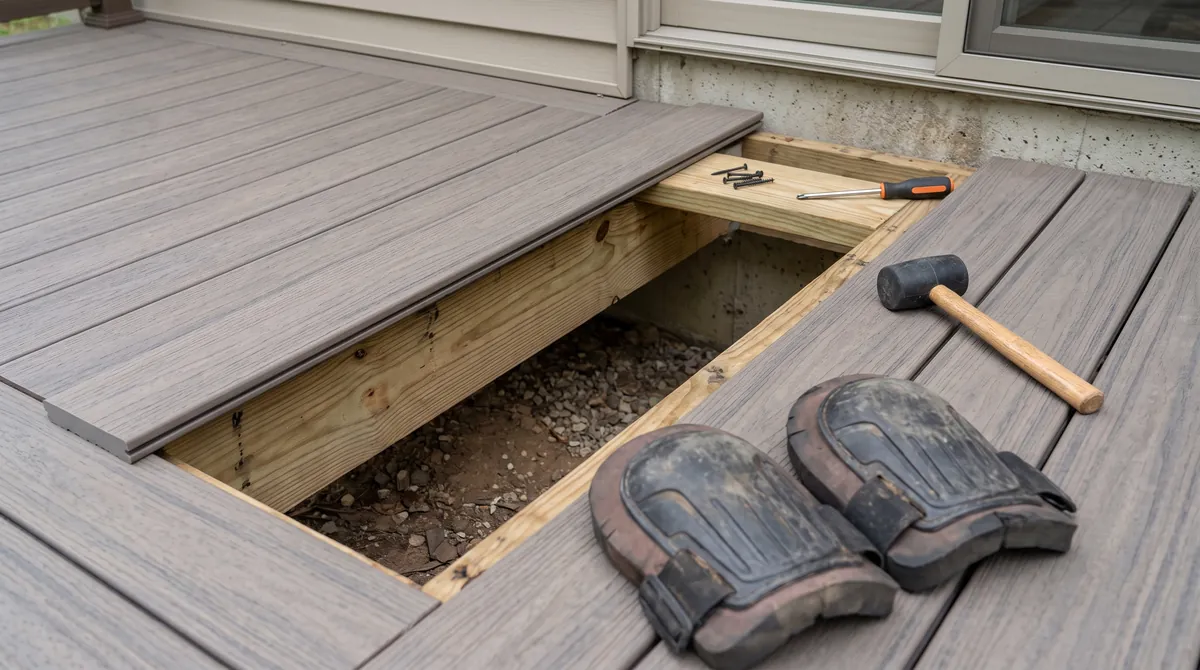
You chose composite to get away from wood upkeep. So a crack across one board, or a dark patch that won't scrub out, can feel like a letdown. Most of the time it isn't.
If a fix reaches the frame, ask the city first: in New Braunfels, a permit is required to repair a structure, not only to build one.
Why does the frame under composite boards matter for a repair?
A new board is only as solid as the joist it's fastened to. The boards can look fine while the wood frame under the composite decking decays. So when a board cracks or works loose, we test the joist below for decay first. Skip that, and you'll be fixing the same spot again.
What is the pick test on a deck?
The pick test is a quick check for decayed wood, made by pushing a sharp tool into it. On a composite deck, we do it on the wood frame under the boards, not on the boards. We press an ice pick or screwdriver into a joist. If it sinks in and the wood feels soft, that joist needs work before new boards go on.
How do you match a new composite board to the old ones?
By its product line, color and profile, read off the boards already on the deck. Composite decking weathers a little over the years, so even a close match can look fresh beside older boards at first. One answer is to shift an older board into the spot people see. The new one then goes where it's out of the way.
What kinds of damage do composite boards get?
Most of it sits on the surface. Here's what you're likely to find:
- marks and stains that look worse than they are
- mildew in the corners that stay shaded
- scratches where chairs and tables get dragged
- now and then, a cracked board or one that's worked loose
The first three are cosmetic. A crack, a board that moves underfoot or a soft spot is different. It can mean the fastening or the frame below has a problem.
That frame is wood, and it can rot while the composite decking above it looks fine. A joist with rot won't hold a composite board for long.
What is done about a damaged composite board?
Start with a bucket and a brush. Composite care is periodic cleaning with soap and water, and plenty of marks that look like damage come right off.
A loose board usually just needs refastening once we've checked what's under it, and a cracked one comes out by itself. The swap tends to go like this:
- We release the hidden fastener clips or face screws holding the board.
- The board comes up, and the joist under it shows.
- We give the joist the pick test.
- A matching board goes down with the same kind of fastening.
The fastening sets the spacing. Some hidden fastener clips create the gap between boards on their own. With face screws, we measure and keep the gap by hand. If the joist fails the pick test, we fix the frame before the new board goes on.
At what point does a repair stop making sense?
When the fixes start to pile up. A repair stops paying off in a few cases:
- the damage runs across many boards, not one or two
- older boards can no longer be matched for color
- the frame has rot in several places
Past that point, a string of repairs costs more over the deck's remaining life than starting over. If the frame is sound, deck resurfacing is the usual next step. The old walking surface and railings come off, and new ones go on the same frame. If the frame isn't sound, you're past resurfacing, and the choice turns to a new deck or a patio in its place.
You can get a head start with your phone. Photograph the damaged boards from above, and from below if you can see under the deck. Note any board that moves underfoot, and if that part of the deck stays shaded or sits near water.
Is your composite deck a cleaning job, a repair or more?
Most composite damage turns out to be a cleaning job or a one-board swap. What makes it bigger is the frame underneath, so let the joists decide how far the work goes.
Boards that need replacing, or a frame that needs a look, call for deck repair. For a bigger job, start with Comal Decks.
Frequently asked questions
Can a cracked composite board be fixed without replacing the deck?
In most cases, yes. One cracked board doesn't doom the boards around it. We release its fasteners, lift it out, and set a matching board in with the same fastening. The crack is a clue, though: movement below can cause it, so the joist underneath gets a look while the board is up.
Why does mildew show up on composite boards?
Mostly because of shade. Mildew is one of the surface problems composite gets, and it tends to show where the deck sees the least sun. It sits on the surface, so treat it as a cleaning job first: soap and water, on a regular schedule. A mark that still won't lift after that may mean the board should be replaced.
Can a loose composite board be refastened instead of replaced?
Usually, yes. A loose board most often means a fastener let go, so we lift it, check the joist under it, and fasten it back down with new hidden clips or screws. If the joist is sound and the board isn't cracked, that's the whole fix. A cracked board gets swapped for a matching one, and a soft joist gets fixed before anything goes back down.
Need a deck repaired?
Tell us what you've found by phone or through the form, and we'll ring you back to plan the fix. Getting a quote won't cost you anything.