
Swapping Wood Deck Boards for Composite: What Has to Change Underneath
Composite can usually replace wood deck boards if the frame under them is sound, and on New Braunfels decks we check that frame first. The joist spacing has to suit it first: for composite, joists generally sit 16 inches on center or closer. The fastening changes too. Hidden fastener clips or face screws hold the new boards, and joist flashing tape can protect the joists under them.
Maybe your deck still feels solid underfoot, but the boards have gone gray, splintered and rough on bare feet. It's fair to wonder if they can simply come off and composite go on. On a lot of decks they can, but the frame sets the terms.
Why are hidden fastener clips used on composite boards?
Hidden fastener clips hold composite boards without screw heads showing, and some set the gap between boards automatically. That gap lets the boards sit flat instead of buckling. Face screws are the other way to fasten them, with every gap measured by hand. Which one you choose shows up in the price and in how the deck looks when it's done.
What happens to the old wood boards when I switch to composite?
We take the old wood boards off first and haul them away. That leaves the frame bare for a close look. That's when you can see the joists, posts and ledger board clearly, along with any rot or rusted fasteners the old surface hid. Removal and hauling are part of the swap, so they're part of what moves its price.
Why won't composite go straight onto every old wood frame?
Two things under the boards decide it: how far apart the joists sit, and what shape they're in. The decking material sets the maximum joist spacing. Wood boards are often laid on joists set wider than composite allows, and composite laid across wide gaps can sag between them.
The second thing is condition. New boards on a failing frame only hide the failure for a while. Before you plan a swap, look under the deck for:
- Soft or crumbling wood in the joists, posts or ledger board, the mark of rot.
- Rusted or corroded fasteners, which are candidates for replacing before new boards go on.
- A ledger board that's soft, stained or pulling away where it attaches the deck to the house.
Any of those means repair work comes before composite, not after.
How does the switch from wood boards to composite work?
A swap usually runs in a set order, and the frame stays where it is the whole time:
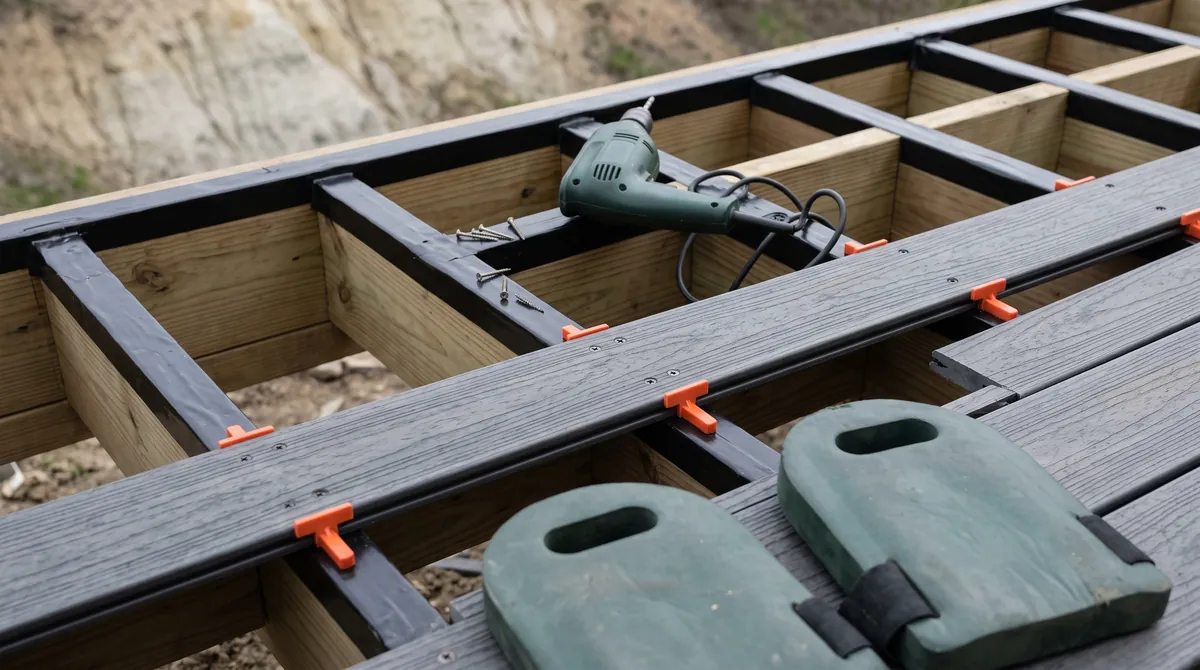
- We take the old decking off, leaving the joists bare.
- We check the frame for joist spacing and overall condition, to see if the substructure is sound.
- We add joists where the spacing is too wide, hung in joist hangers.
- Joist flashing tape can go over the joists to help the substructure last.
- The composite decking goes down with hidden fastener clips or face screws.
The fastening choice changes how the gap between boards is set. Some hidden fastener clips set it for you. With face screws, we measure and keep it by hand. That gap isn't cosmetic: boards laid without it can buckle into ripples, and in bad cases into trip hazards or fastener failure. The same fastening is also what lets a damaged composite board come up on its own later.
What should you check before ordering composite boards?
Order boards last. A few checks first keep you from buying the wrong thing:
- The frame has passed its check, with soft joists or rusty fasteners dealt with.
- The joist spacing suits the boards you picked, not just composite in general.
- The city's approval is in hand if your home is in one of the city's historic districts or is a landmark, since it's required before any exterior work; the city sets out how to apply for one.
- You've chosen the fastening, hidden fastener clips or face screws.
Then pick the board line. Standard composite decking, capped composite decking and PVC decking each price differently.
Timing matters too. If the railing is going to change, change it with the boards, because taking it off twice adds labor. Worn stairs are usually redone at the same time, so the new boards run all the way to the ground. Photos from above and underneath the deck make any price you get easier to pin down.
Is your deck ready for composite boards?
If the frame is sound and the joists sit close enough, a board swap gives you a low-upkeep deck without a rebuild. If they don't, the frame work comes first, and it's better to learn that before the boards are paid for.
For the swap itself, start with deck board replacement. For anything bigger than boards, from new framing to a whole new deck, start from Comal Decks.
Frequently asked questions
Can I replace wood deck boards with composite?
Usually, as long as the frame is sound and its joists sit close enough. Composite needs more support than many wood boards get, so a deck framed wide needs extra joists before the switch. Rot, corroded fasteners or a soft ledger board get fixed first too. Have the frame looked over before you price any boards, since it decides what the job really is.
Do I have to add joists for composite every time?
No. They go in only where the existing spacing is wider than composite allows. If yours already sit at 16 inches on center or tighter, the frame may need only repairs and joist flashing tape. Measure from the center of one joist to the next in a few places to get a feel for it.
Should the railing be changed when the boards go to composite?
It doesn't have to be: if the railing is solid and firmly in place, it can stay. It's often changed with the boards so the two match and the railing comes off only once. If its posts are soft or loose, lean toward replacing it. A railing is only as steady as what holds it up.
Got a few boards to swap?
Send the form with your board count or give us a call, and we'll ring you back about the swap. A close-up of the worst board helps.